
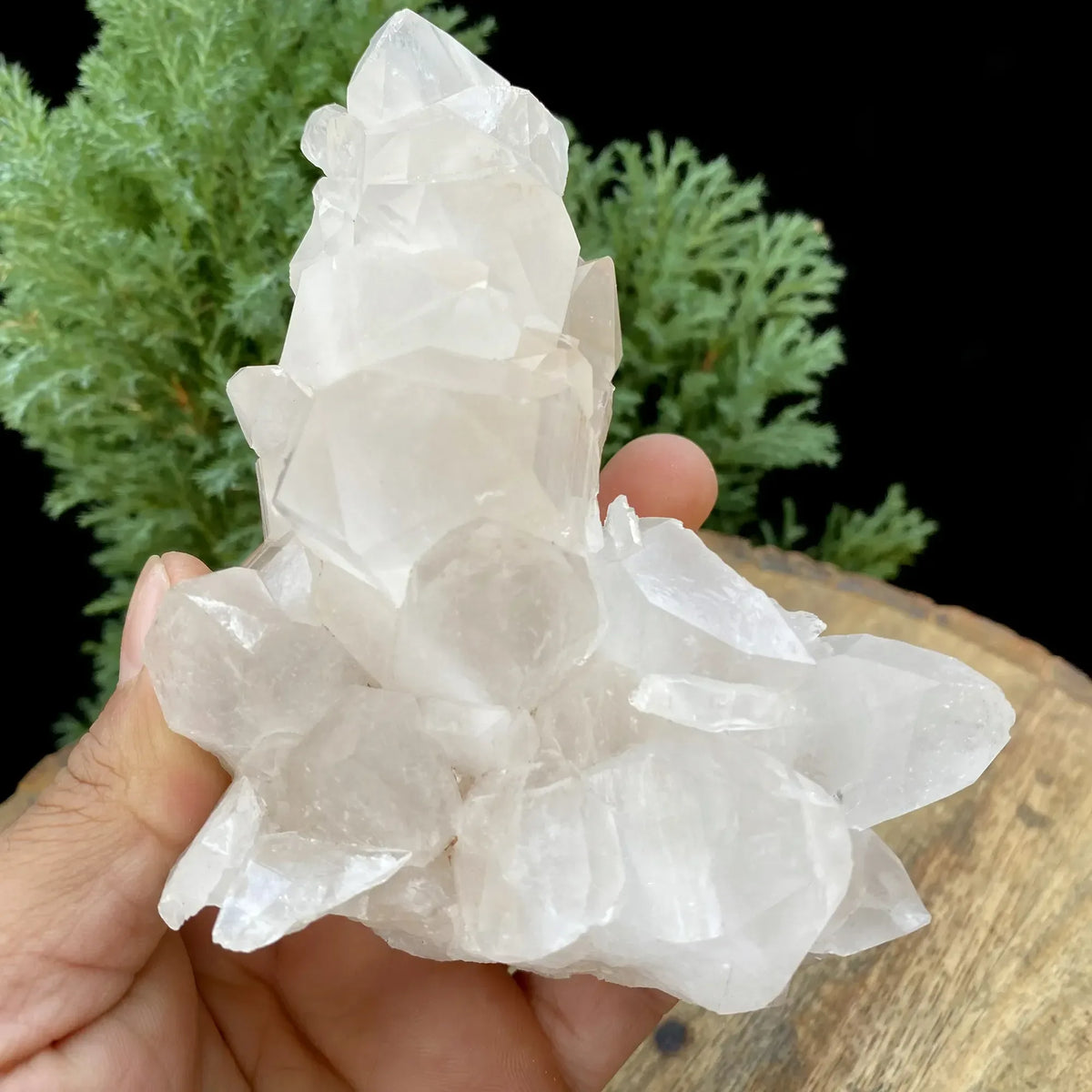
Himalayan clear quartz is sought after for its natural clarity, crystal form and connection to quartz-producing regions of the Himalayas. No two pieces are exactly alike. Some are water-clear, while others contain veils, internal fractures, mineral inclusions, growth lines or subtle cloudy zones that record the conditions in which the crystal formed.
For collectors, understanding those natural features is more useful than judging a specimen by clarity alone. This guide explains how Himalayan clear quartz forms, what to look for in a natural specimen and how to compare pieces when buying online.
What is Himalayan clear quartz?
Clear quartz is crystalline silicon dioxide. The word “Himalayan” describes the geographic origin used for specimens sourced from Himalayan mineral-producing areas. A natural specimen may occur as a single point, a group of intergrown crystals or a cluster with matrix attached.
Even quartz described as clear can contain visible internal features. Mineral growth is rarely perfectly uniform, so small veils, wisps, fractures and inclusions are normal. In many collector specimens, these details are part of the appeal because they make the piece identifiable and unique.
How Himalayan quartz forms
Quartz grows when silica-rich fluids move through fractures and cavities in rock and the right temperature and pressure conditions allow crystals to develop. Growth can happen in stages. Changes in fluid chemistry, temperature or available space can produce zoning, included minerals, phantoms and other internal structures.
This staged growth helps explain why one crystal may be highly transparent while another from the same broader region contains dramatic internal features. A cluster can even show several crystal habits at once.
How to identify natural clear quartz
Begin with the overall crystal form. Natural quartz commonly develops six-sided prisms terminating in pointed faces, although contact with surrounding crystals or rock can interrupt the shape. Examine the surface for natural growth lines, irregularities and areas where crystals intersect.
Inside the specimen, look for believable variation rather than perfect uniformity. Natural inclusions, tiny internal fractures and changes in transparency are common. A crystal does not need to be flawless to be genuine or collectible.
Photographs should ideally show the actual specimen from several angles. When buying a one-of-a-kind mineral, exact weight and dimensions are also important because image scale can be misleading.
Clear quartz, milky quartz and included quartz
The terms are related but describe different appearances. Clear quartz allows relatively strong light transmission. Milky quartz has a more opaque or cloudy white body caused by numerous microscopic inclusions or internal features. Included quartz contains visible minerals, veils or other material inside the host crystal.
A single Himalayan quartz cluster can contain areas that fit more than one of these descriptions. That is normal in natural mineral specimens.
What makes a Himalayan clear quartz specimen collectible?
Collectors may value different features. Some prioritize high transparency and sharp terminations. Others prefer complex clusters, unusual growth habits, mineral inclusions or a strong natural base. The best specimen is therefore not automatically the clearest one; it is the piece whose combination of form, condition, provenance and internal character appeals to the collector.
When comparing pieces, check for intact primary points, attractive composition, natural lustre and accurate disclosure of chips, contact points or repairs. Weight and dimensions should be listed so you can understand the physical scale.
Traditional meaning of clear quartz
Clear quartz has a long-standing place in modern crystal traditions and is often symbolically associated with clarity, focus and intention. Some people use quartz during meditation or keep it in a personal space as a visual reminder of those ideas.
These are traditional or spiritual associations, not medical claims. Quartz should never replace qualified healthcare or evidence-based treatment.
How to care for natural quartz
Quartz is relatively durable, but clusters may have small points that can chip if struck. Handle the specimen by a stable base rather than delicate terminations. For dust, start with a soft brush. If a specimen needs deeper cleaning, use methods suitable for all minerals present in the piece; included specimens may contain materials that react differently from quartz itself.
For display, indirect daylight can reveal internal veils and inclusions without the harsh reflections created by direct flash. A simple neutral background also makes the crystal structure easier to appreciate.
Learn more about Himalayan quartz
For a broader introduction, read our Himalayan quartz guide. If you are interested in internal growth patterns, our guide to white and green phantom quartz explains how phantom structures differ from ordinary inclusions.
Himalaya Quartz focuses on natural, individually photographed specimens so the formation you see is the specimen you are evaluating.